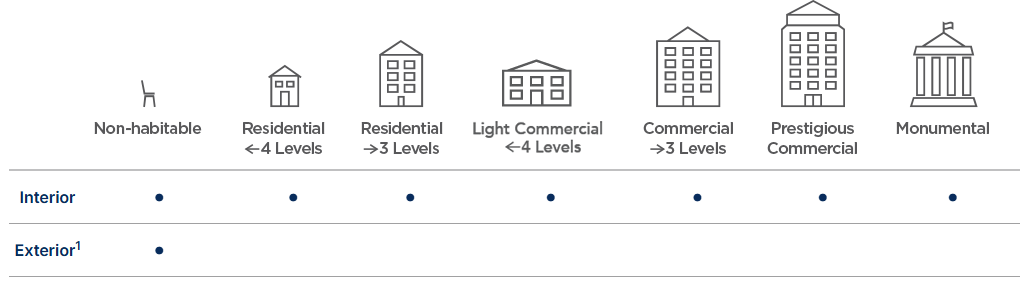
Fun, bright solid colours that produce a big impact, delivered with tough polyester thermosetting powder.

It is ideal for use:

  • On pre-treated architectural grade aluminium
  • On mild steel, bright/semi bright steel, black steel and blue steel
  • In mild exterior conditions
  • In general interior conditions
  • In environments greater than 500m from the high tide mark
  • On the following projects:

Alphatec® is only suitable for coastal environments >500m from the high tide line and are NOT suitable in strongly acidic or caustic environments so PH must be >5 and <9.

Features

  • Tough polyester thermosetting powder coating
  • Range of fun, bright solid colours

Benefits

  • Hard wearing finish
  • Versatile range for non-architectural projects


Product Information

Project Types

Exterior projects


  • Non-habitable


Interior projects (All BCA Classes)


  • All commercial buildings
  • All residential buildings
  • Non-habitable

Uses

Developed for use over various substrates including steel and aluminium on interior and non architectural exterior product applications combined with excellent overall performance. Examples include: interior furniture and storage equipment, electrical cabinets other industrial metal products such as bicycles, garden tools, lawn mowers, and automotive components.

Surfaces

Ideal for use over:
  • Architectural aluminium including perforated aluminium
  • Mild steel, bright/semi bright steel, black steel and blue steel and
  • Galvanised steel, stainless steel, zincalume, non ferrous metals.

Technology

Polyester thermosetting powder

Range

Alphatec®

Look

Bright solid

Finish

Gloss

Interior or Exterior

Interior and exterior use

Product Performance Radar

See how this product rates on selected measures below.

Scale

Superior: 5

Excellent: 4

Very good: 3

Good: 2

OK: 1

Not Applicable: 0

Description of measures:


  • Exterior colour & chalking resistance – The powder coated film's resistance to colour fading and chalking in exterior conditions during its warrantable period (in accordance with the Dulux Care & Maintenance program).
  • Exterior film durability – The powder coated film's resistance to peeling, cracking or flaking during its warrantable period (applicable to aluminium substrates only) (in accordance with the Dulux Care & Maintenance program).
  • Corrosion resistance - The powder coated system's resistance to corrosion during its warrantable period (applicable to steel substrates only)
  • Film Hardness – The powder coated film's resistance to gouging or rupturing.
  • Low energy curing – Some powder coating ranges enable a reduction in energy consumption through lower oven temperatures, and or faster line speeds.
  • Mar and scuff resistance – The powder coated film's ability to resist the visible mar and scuffing that can happen during transportation, fabrication, onsite during construction and service life when compared to smooth powder coat finishes.
  • Reaction to fire testing – A powder coated film's performance to industry standard ‘reaction-to-fire’ tests that have been carried out for the Dulux powder coating ranges in accordance with the Australian and New Zealand building codes.
  • VOC (Volatile Organic Compounds) – Powder coating films produce negligible total VOCs and formaldehyde emissions which is especially important in indoor environments.

Visit the contact us page to get in touch.


Pre-treatment of Aluminium

The pre-treatment process must be capable of meeting the performance outputs as described in AS3715. Compliance to appropriate process parameters is essential in ensuring compliance to etch, conversion coating weights (time/concentration) and conductivity of the final rinse.

Etch

The etch process is a very important stage of pre-treatment and close consultation with your pre-treatment supplier is strongly recommended to ensure optimum adhesion & corrosion resistance is obtained. As an approximate guide:

  • An etch rate of >1gm/m2 , is recommended for Alphatec projects greater than 500 metres from the coastline, but etch rate advice from pre-treatment suppliers should be taken into consideration.

Conversion Coatings

This is the next pre-treatment process for aluminium to ensure that it is suitably prepared for coating. It is recommended that Chrome conversion weights shall be a minimum of 431mg/m2, but advice from pre-treatment suppliers should be taken into consideration.

  • For Chrome pre-treatment a Supplier ‘Certificate of Analysis’ should be provided by the customer and attached to Self-Assessment Declaration.
  • Non Chrome conversion coatings should be applied and maintained in accordance with the manufacturer’s instructions.

Final Rinse

Final rinse is to ensure optimum surface preparation prior to coating.

  • Final rinse water run-off from the extrusion shall have a recommended conductivity of less than 80 micro Siemens/cm.
  • The maximum time between pre-treatment and the application of the powder coating is 24 hours.
  • The entire area of the aluminium shall be properly pre-treated, appropriate spacing devices should be used.

Handling

Care should be taken with handling to ensure health and safety measures are met and that the substrate is not contaminated.

  • Pre-treated sections must never be handled with bare hands. Clean and lint free cotton gloves must be worn at all times when handling pre-treated sections.

Dry Off Oven (if applicable)

If your site uses a dry off oven to assist in the pre-treatment process, consult your pre-treatment supplier for advice, but generally;

  • < 75° C for chrome pre-treatment
  • < 120° C for chrome-free pre-treatment
  • Applicators must be able to demonstrate compliance with this specification.

Pre-treatment of Steel

Steel substrates shall be prepared as follows:
1. Wash and degrease all surfaces to be coated in accordance with AS1627.1 with a free-rinsing, alkaline detergent, in strict accordance with the manufacturer’s written instructions and all safety warnings.
2. Wash with fresh potable water and ensure that all soluble salts are removed in accordance with AS 3894.6 methods A&D.
3. Grind all sharp edges with a power tool to a minimum radius of 2mm.
4. Power tool clean welds to AS1627.2 Class 2 to remove roughness. Remove filings, preferably by vacuum or compressed air.
5. Abrasive blast clean all steel surfaces to be painted in accordance with AS1627.4 to visual standard AS1627.9 Class 2.5 (equivalent to ISO8501-1, Sa 2.5: Very Thorough Blast-Cleaning). Use a medium that will generate a surface profile of 35 to 65 microns (as tested to AS3894.5 Method A.) In situations where it is not possible to prepare your item on all surfaces as described above, for long term protection against corrosion it is strongly recommended whenever possible, that an alternative substrate such as, aluminium be considered.
6. The steel is to be stored in an area which is clean and dry
7. The steel must be coated within 4 hours of blasting.

Application Method

Electrostatic Spray

Cure Schedule for Alphatec

Metal Temperature:
210° : 4 mins minimum
200° : 5 mins minimum
180° : 8 mins minimum

Cure Schedule for Alphatec with RapidCure

Metal Temperature:
200° : 2 mins minimum
180° : 5 mins minimum
160° : 10 mins minimum 


Please note: All RapidCure products can be applied at standard temperatures, but benefits from possible reduction in energy consumption or faster line speeds will be lost.
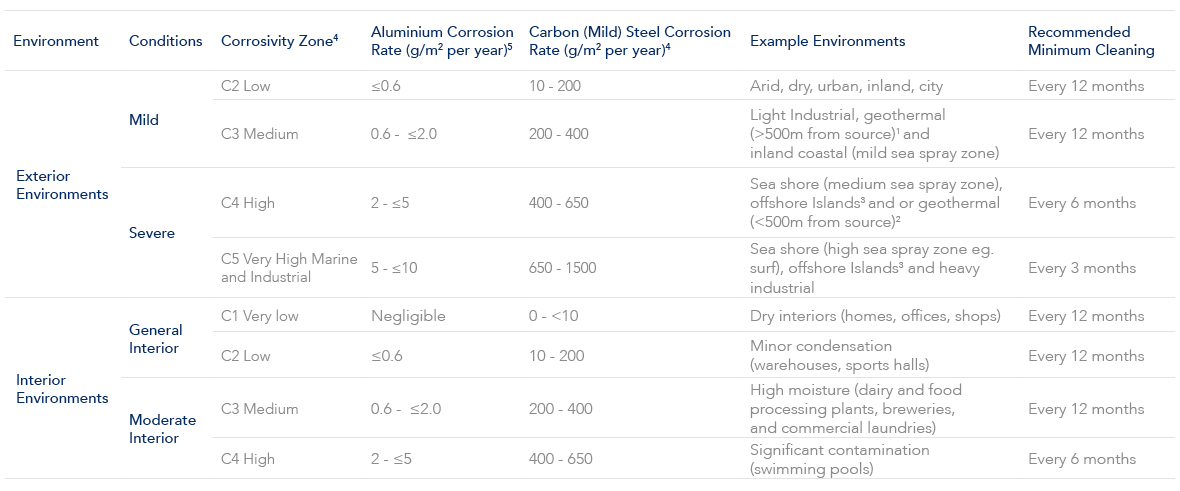
1. Geothermal environments greater than 500m of a bore, mud pool, steam vent, or other source with a pH between 5 and 9. For pH outside this consult Dulux.
2. Geothermal hot spots within 500m of a bore, mud pool, steam vent, or other source.
3. All offshore islands including Waiheke, Stewart Island, Fraser Island and Pacific islands eg PNG, Fiji, Samoa, Tonga, Tahiti, Noumea
4. The corrosion rates for the first year of exposure for the different corrosivity categories of Aluminium and Carbon (Mild) Steel are determined by the following standards:
AS 4312 – Atmospheric corrosivity zones in Australia.
AS 2312.1:2014 – Guide to the protection of structural steel against atmospheric corrosion by the use of protective coatings. Part 1: Paint coatings
ISO 9223:2012 – Corrosion of metals and alloys – Corrosivity of atmospheres – Classification, determination and estimation
5. The corrosion rates for the first year of exposure for the different corrosivity categories of Aluminium are determined by the following standard:
ISO 9223:2012 – Corrosion of metals and alloys – Corrosivity of atmospheres – Classification, determination and estimation

Project Suitability – Aluminium

Use the following table to help identify where Alphatec can be applied on aluminium projects. Refer to the conditions information to determine the environment that your project will be exposed to.
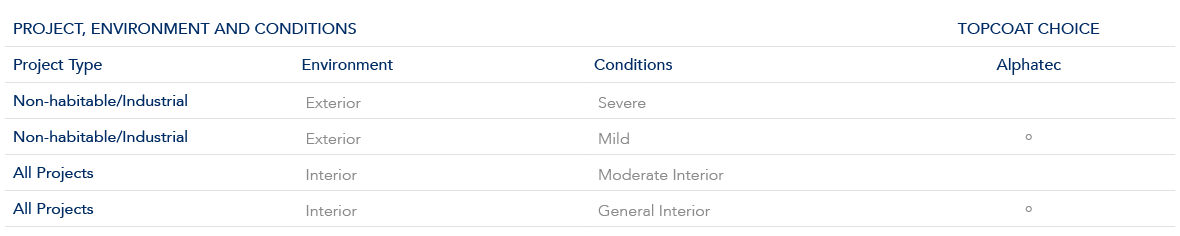
Alphatec is only suitable for coastal environments >500m from the high tide line and are NOT suitable in strongly acidic or caustic environments so PH must be >5 and <9.

Project Suitability – Steel

Use the following table to help identify where Alphatec can be applied on steel projects. Refer to the conditions information to determine the environment that your project will be exposed to.

  • Non-warrantable

Alphatec is only suitable for coastal environments >500m from the high tide. All Dulux powder products are NOT suitable in strongly acidic or caustic environments so PH must be >5 and <9.

Conditions – Alumi and Steel

Use the following table which references AS2312.1, AS 4312 and ISO 9223 to identify the environment, conditions and atmospheric corrosivity categories to pinpoint your projects corrosivity zone this table should be used together with the corrosivity zone maps contained within AS 4312.
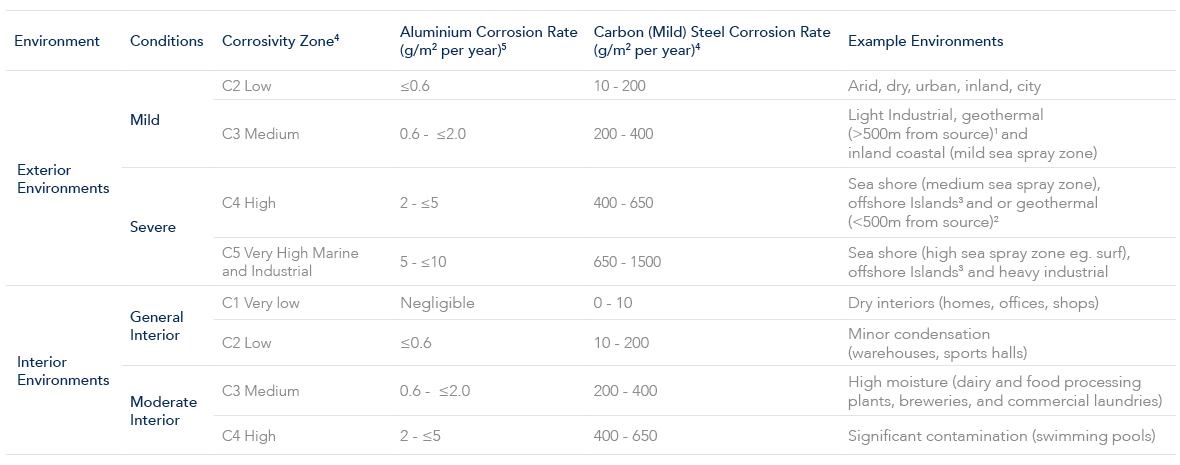
TABLE-08-1
1. Geothermal environments greater than 500m of a bore, mud pool, steam vent, or other source with a pH between 5 and 9. For pH outside this consult Dulux. 2. Geothermal hot spots within 500m of a bore, mud pool, steam vent, or other source. 3. All offshore islands including Waiheke Island, Stewart Island, Fraser Island and Pacific islands eg PNG, Fiji, Samoa, Tonga, Tahiti, Noumea 4. The corrosion rates for the first year of exposure for the different corrosivity categories of Aluminium and Carbon (Mild) Steel are determined by the following standards: AS 4312 – Atmospheric corrosivity zones in Australia. AS 2312.1- Guide to the protection of structural steel against atmospheric corrosion by the use of protective coatings. Part 1: Paint coatings ISO 9223 – Corrosion of metals and alloys – Corrosivity of atmospheres – Classification, determination and estimation 5. The corrosion rates for the first year of exposure for the different corrosivity categories of Aluminium are determined by the following standard: ISO 9223- Corrosion of metals and alloys – Corrosivity of atmospheres – Classification, determination and estimation

Advice Line

Our dedicated consultants can help simplify the specification process, saving you time and money by providing the right coating advice for your project. Call 13 24 99 For a comprehensive overview and specific specification details on aluminium and steel click here.

Colour Solutions

Tech Advice


Colours displayed should be used as a guide for your colour selection. 
Always confirm your colour choice with a production line prepared swatch for final colour approval.


Alphatec®

The Alphatec® range has fun, bright solid colours for a big impact delivered with tough polyester thermosetting powder.

Lemon Yellow

Gloss

98432120

Pink Spell

Gloss

9844480G

Blaze Blue

Gloss

98419941

Mamba Green

Satin

9846538S

Yellow Gold

Gloss

98433617

R13 Signal Red

Gloss

9844481G

French Blue

Gloss

98432725

Mistletoe

Gloss

98451040

Safety Yellow

Gloss

9842015G

Flame Red

Gloss

98419959

Pommel Blue

Gloss

98451034

Egyptian Teal

Gloss

9846536G

Switchboard Orange

Gloss

9844207G

X15 Orange

Gloss

9844461G

Space Blue

Gloss

98419990

Dark Violet

Gloss

98451926